
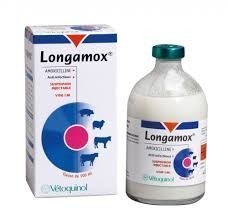

longamox is amoxicillin trihydrate, a semi-synthetic antibiotic belonging to the penicillin group.Amoxicillin has a bactericidal action: it acts through the inhibition of synthesis of the cell wall of bacteria in growth phase. In contrast to penicillin G, it presents a broad spectrum toward Gram-negative bacteria but remains sensitive to penicillinase.
Micro-organisms inhibited by concentration ≤ 0.5ug/ml are considered to be very sensitive. They include most of the Gram-positive bacteria and numerous Gram-negative micro-organisms, especially Pasteurella, major pathogens of respiratory infections in cattle. Gram-negative bacteria with MIC varying from 0.5 to 1.25 ug/ml are also considered to be sensitive.
Longamox is a long-acting formulation. It has prolonged resorption from the injection site which ensures a continuous intake of amoxicillin in the blood circulation and therefore in all the body.
The maximal serum concentration is observed about two hours after administration.
Amoxicillin is partly bound to plasma proteins (17 to 20%). It distributes very broadly in the body. It is partly bio-transformed (<25%) to inactive penicilloic acid and is excreted in the non-metabolised form, principally in the urine. There is also a biliary and eventually milk elimination.
Physio-Chemical Characteristics:
Longamox is an oily suspension and one of its main, original features is a new concept of patented excipient, specially designed by Vetoquinol.
This formulation, created for the manufacturing of long acting suspensions, is a controlled release system for hydrosoluble active ingredients.
In such compositions, the release of active compounds is usually obtained by addition of a viscosity agent or by coating the active ingredient particles before incorporating them in the liquid excipient (when the active ingredient itself is not a long-acting derivative). In the first option, the product generally is not homogenous, and the injection is difficult and painful for the animal. All other veterinary applications for injectable suspensions use that process, often using aluminium stearate.
The coating of active ingredient is generally difficult to achieve, and the manufacturing process is long and expensive. This process has no applications in the veterinary field of injectable suspensions.
This new concept is based on the presence of molecules of a hydrophilic and bio-compatible polymer, in suspension in liquid vehicle.
This polymer is non-soluble and non-gelifiable in that vehicle, but it will gelify into the biological fluids.
This new composition is perfectly homogeneous and easy to inject without pain.
After the injection into the animal, the particles of hydrophilic polymer come into contact with the aqueous biological fluids, and develop into a gel with perfect tolerance. The active ingredient is contained by this gel and is slowly released outside the gel.
Infections due to organisms sensitive to Amoxicillin including:
Cattle/Sheep:
Treatment of respiratory infections due to Pasteurella multocida and Pasteurella haemolytica.
Pigs:
Treatment of respiratory infections due to Pasteurella multocida and Actinobacillus pleuropneumoniae.
Contraindications:
Allergy to Beta-lactam antibiotics.
Adverse Effects:
Hypersensitivity reactions and may also alter gut flora possibly causing antibiotic diarrhoea.
Dosage and Administration:
15mg/kg (i.e. 1 ml of suspension for 10kg body weight) twice at a 48-hour interval by intramuscular injection into the anterior half of the neck.
Inject a maximum volume of 20ml per injection site.
Withholding Times:
Cattle:
Meat 35 days, milk 60 hours
Sheep:
Meat 21 days
Pigs
Meat 21 days
Not for use in lactating sheep.


Reviews
There are no reviews yet.