

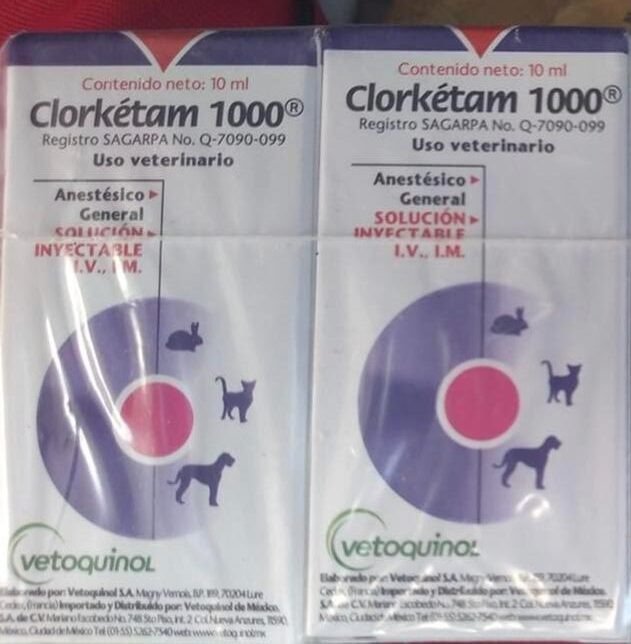
Buy Clorketam 1000 Online
Clorketam 1000 is a high-concentration veterinary anesthetic solution formulated for general anesthesia, immobilization, and procedural sedation in animals. Containing Ketamine Hydrochloride ($100\text{ mg/mL}$ equivalent to $1000\text{ mg/10 mL}$ or $1000\text{ mg/100 mL}$ total concentration formulations), Clorketam 1000 is widely utilized across equine, canine, feline, exotic, and livestock veterinary medicine.
As a dissociative anesthetic agent, Clorketam 1000 induces profound somatic analgesia and sedation while maintaining protective pharyngeal and laryngeal reflexes. It is typically combined with sedatives, tranquilizers, or muscle relaxants to ensure balanced anesthesia, smooth induction, and muscle relaxation during surgical and diagnostic procedures.
What Is Clorketam 1000?
Clorketam 1000 is a sterile parenteral anesthetic solution containing Ketamine Hydrochloride as its active pharmaceutical ingredient (API). Classified as an NMDA ($N$-methyl-$D$-aspartate) receptor antagonist, it produces a state of “dissociative anesthesia,” characterized by:
-
Somatic Analgesia: Potent suppression of central pain signaling pathways.
-
Superficial Sleep/Sedation: Unconsciousness where the animal appears disconnected from its environment.
-
Preserved Autonomic Reflexes: Maintenance of normal corneal, pedalling, and swallowing/cough reflexes.
-
Cardiovascular Support: Mild sympathomimetic action that helps maintain blood pressure and heart rate during induction.
Product Overview
Achieving safe, effective surgical restraint requires reliable induction agents. Clorketam 1000 provides rapid, predictable anesthetic induction across multiple species. Because ketamine used alone can cause hypertonicity and muscle rigidity, it is universally co-administered with $\alpha_2$-adrenoreceptor agonists (e.g., Xylazine, Medetomidine, Detomidine) or benzodiazepines (e.g., Diazepam, Midazolam) to yield smooth muscle relaxation and balanced surgical depth.
| Characteristic | Specification Detail |
| Product Name | Clorketam 1000 |
| Active Ingredient | Ketamine Hydrochloride ($100\text{ mg/mL}$) |
| Pharmacological Class | Dissociative Anesthetic / NMDA Receptor Antagonist |
| Formulation | Sterile Clear Aqueous Injectable Solution |
| Primary Target Species | Equine (Horses), Canines, Felines, Livestock, Exotics |
| Route of Administration | Intravenous (IV), Intramuscular (IM) |
| Controlled Drug Status | Controlled Substance (Schedule varies by jurisdiction) |
| Regulatory Category | Prescription Veterinary Anesthetic |
Key Features of Clorketam 1000
-
Potent Dissociative Anesthesia: Rapid onset of surgical anesthesia and somatic analgesia.
-
Cardiovascular Stability: Increases or maintains blood pressure and heart rate, unlike many central nervous system depressants.
-
Versatile Multi-Species Protocol: Effective for horses, cattle, dogs, cats, small ruminants, and zoological species.
-
Combination Flexibility: Integrates seamlessly into balanced protocol mixtures with Xylazine, Detomidine, Diazepam, or Propofol.
-
Preserved Airway Reflexes: Maintains pharyngeal tone, helping preserve open airways during short field procedures.
Product Specifications and Presentations
Clorketam 1000 is manufactured under stringent pharmaceutical standards to ensure sterility, pyrogen-free quality, and concentration precision:
-
Concentration: $100\text{ mg}$ Ketamine base per $\text{mL}$ ($100\text{ mg/mL}$).
-
Total Vial Content: Commonly supplied in $10\text{ mL}$, $50\text{ mL}$, or $100\text{ mL}$ multi-dose amber glass vials.
-
Excipients: Benzethonium chloride or chlorobutanol as a preservative, in water for injection, pH adjusted.
-
Appearance: Clear, colorless to almost colorless solution.
How Clorketam 1000 Works (Mechanism of Action)
Ketamine operates primarily through non-competitive antagonism of central $N$-methyl-$D$-aspartate (NMDA) receptors:
                           [ Clorketam 1000 Injection ]
                                        │
           ┌────────────────────────────┴────────────────────────────┐
           ▼                                                         ▼
[ Non-Competitive NMDA Receptor Blockade ]                 [ Inhibition of Glutamate Pathways ]
           │                                                         │
           ▼                                                         ▼
[ Dissociation of Thalamocortical & Limbic Systems ]      [ Blockade of Central Sensitization & Wind-Up ]
           │                                                         │
           ▼                                                         ▼
[ Somatic Analgesia & Dissociative State ]               [ Prevention of Hyperalgesia ]
           │                                                         │
           └────────────────────────────┬────────────────────────────┘
                                        │
                                        ▼
             [ Surgical Anesthesia (When Paired with Muscle Relaxants) ]
-
Thalamocortical Dissociation: Electrically dissociates the limbic system from the neocortex, blocking conscious perception of pain inputs while leaving lower brainstem centers active.
-
NMDA Antagonism & Wind-Up Prevention: Prevents central sensitization (“wind-up” pain), providing crucial perioperative somatic pain relief.
-
Sympathomimetic Stimulation: Inhibits neuronal catecholamine reuptake, resulting in mild sympathetic stimulation that supports mean arterial blood pressure.
Intended Veterinary Context and Clinical Uses
1. Equine Surgical Induction & Field Anesthesia
Used in horses following premedication with an $\alpha_2$-agonist (e.g., Xylazine or Detomidine) to achieve smooth recumbency for short field surgeries (castrations, wound debridement) or prior to volatile gas anesthesia maintenance.
2. Small Animal Anesthesia (Dogs & Cats)
Combined with Medetomidine, Diazepam, or Acepromazine for short diagnostic or minor surgical procedures, dental prophylaxis, or intubation induction.
3. Livestock & Exotic Animal Immobilization
Utilized in cattle, sheep, goats, and wildlife for restraint, field surgeries, and emergency therapeutic interventions.
Veterinary and Animal Safety Considerations
+-----------------------------------------------------------------------------------+
|                                 SAFETY WARNING                                    |
|  1. MUST BE USED WITH A MUSCLE RELAXANT OR SEDATIVE (e.g., Xylazine, Diazepam).   |
|     Sole use of Ketamine causes hypertonia, muscular tremors, and rough recovery. |
|  2. CONTROLLED SUBSTANCE: Handle, log, and store according to national laws.       |
|  3. PROTECT FROM ACCIDENTAL SELF-INJECTION.                                      |
+-----------------------------------------------------------------------------------+
-
Muscle Rigidity: Ketamine alone produces hypertonia and muscle spasms. Co-administration with a sedative or muscle relaxant is mandatory for balanced anesthesia.
-
Ocular Protection: Because animals under ketamine keep their eyes open with dilated pupils, corneal lubricant ointment must be applied to prevent corneal drying and damage.
Benefits and Important Considerations
Benefits
-
Rapid Onset: Intravenous administration produces anesthesia within 30 to 60 seconds; intramuscular injection acts within 3 to 5 minutes.
-
Strong Somatic Analgesia: Excellent control of skin, bone, and joint pain.
-
Cardiovascular Safety Margin: Ideal for patients where severe blood pressure drops must be avoided.
Considerations
-
Visceral Analgesia: Poor visceral pain control; additional analgesics (such as opioids or NSAIDs) are required for abdominal or soft-tissue surgery.
-
Rough Recovery: Emergence delirium or twitching can occur if sedatives wear off before the ketamine clears.
Administration, Dosage, and Handling
Note: Dosing regimens must be calculated by a licensed veterinarian based on species, body weight, health status, and concurrent premedications.
General Dosage Guidelines (Reference Only)
-
Equine Field Induction: Following full sedation with Xylazine ($1.1\text{ mg/kg}$ IV), Clorketam 1000 is typically dosed at $2.2\text{ mg/kg}$ IV ($2.2\text{ mL}$ per $100\text{ kg}$).
-
Canine/Feline Protocols: Dosed according to combination protocols (e.g., Ketamine/Valium IV or Ketamine/Medetomidine IM) at calculated mg/kg levels under strict monitoring.
-
Monitoring: Continuously monitor respiratory rate, pulse quality, mucosal color, and body temperature throughout procedure and recovery.
Important Safety Information, Precautions, and Contraindications
-
Contraindications: Do not use in animals with severe hypertension, head trauma/increased intracranial pressure, intraocular pressure lesions, or severe hepatic/renal failure.
-
Seizure History: Use with caution in animals with pre-existing epileptic or seizure disorders.
-
Pharyngeal Stimulation: Pharyngeal reflexes remain active; avoid triggering laryngospasm unless the airway is secured.
Storage and Handling Guidelines
-
Temperature: Store between 15°C and 25°C (59°F to 77°F). Protect from freezing.
-
Light Protection: Keep vials inside original outer cartons to shield from UV exposure.
-
Controlled Storage: Store in a locked cabinet or safe in accordance with local laws governing controlled veterinary drugs.
Purchasing Considerations for Controlled Anesthetics
When procuring Clorketam 1000 online:
-
Licensing & Authorization: Purchasing requires valid veterinary credentials and compliance with controlled substance regulations in your jurisdiction.
-
Authenticity: Sourcing from verified pharmaceutical distributors guarantees exact chemical purity, sterility, and correct concentration.
-
Packaging Integrity: Ensure vials arrive with undamaged tamper-evident seals and intact batch tracking information.
Where To Buy Clorketam 1000 Online
Acquiring genuine veterinary anesthetics and clinical supplies is vital for animal welfare, surgical safety, and practice management. World Equine Vet provides access to high-grade veterinary pharmaceuticals, surgical equipment, and performance care supplies for equine clinics, livestock operations, and licensed veterinarians worldwide.
At World Equine Vet, we uphold strict quality standards, professional verification, and secure fulfillment.
-
Explore our catalog of veterinary anesthetics and pharmaceuticals on the World Equine Vet platform.
-
Review technical documentation and administration resources.
-
Benefit from professional packaging and dependable international delivery.
Visit World Equine Vet today to explore our full selection of veterinary products.
Frequently Asked Questions (FAQs)
1. What is Clorketam 1000 used for in animals?
Clorketam 1000 (Ketamine HCl $100\text{ mg/mL}$) is used as a dissociative anesthetic for surgical induction, short-term procedural restraint, and somatic pain control in horses, dogs, cats, livestock, and exotic animals.
2. Can Clorketam 1000 be used alone?
No. Ketamine used alone causes muscle rigidity and rough recovery. It must always be combined with sedatives or muscle relaxants such as Xylazine, Detomidine, or Diazepam.
3. How quickly does Clorketam 1000 take effect?
When administered intravenously (IV), effect occurs within 30–60 seconds. When given intramuscularly (IM), onset takes 3–5 minutes.
4. Is Clorketam 1000 a controlled substance?
Yes. Ketamine Hydrochloride is a controlled substance in most countries due to its potential for misuse. Purchase and administration require authorized veterinary licensing.
5. How should Clorketam 1000 be stored?
Store in a locked safe or cabinet at controlled room temperature (15°C–25°C), protected from direct light.
Buy Clorketam 1000 Online
Clorketam 1000 is a fundamental veterinary anesthetic providing rapid dissociative induction, strong somatic analgesia, and reliable cardiovascular support. When paired with appropriate sedatives and muscle relaxants, Clorketam 1000 ensures effective, controlled anesthesia across equine, small animal, and livestock practice. Safe use demands precise professional dosing, appropriate patient monitoring, and full regulatory compliance.
For verified veterinary pharmaceuticals and surgical supplies, visit World Equine Vet.
CLORKETAM 1000 is a sterile injectable solution that can be administered intramuscularly and intravenously in laboratory animals, canines and domestic cats.
Ketamine
Ketamine hydrochloride (a derivative of Ketamine) is reported as an ingredient of Clorketam 1000 in the following countries:France CLORKETAM 1000
Important Notice: The Drugs.com international database is in BETA release. This means it is still under development and may contain inaccuracies. It is not intended as a substitute for the expertise and judgement of your physician, pharmacist or other healthcare professional. It should not be construed to indicate that the use of any medication in any country is safe, appropriate or effective for you. Consult with your healthcare professional before taking any medication.Further information for CLORKETAM 1000
Always consult your healthcare provider to ensure the information displayed on this page applies to your personal circumstances.
Cis a sterile injectable solution that can be administered intramuscularly and intravenously in laboratory animals, canines and domestic cats.Due to these properties, is indicated in numerous surgical interventions: superficial and short-term interventions, scheduled surgical interventions, urgent interventions, even in pregnant females, obstetric interventions, among others. Depending on the nature of the intervention, CLORKÉTAM 1000 can be administered after a premedication (acepromazine, glucopyrrolate, diazepam, droperidol, etc.).
On the other hand, chlorobutanol has antibacterial and antifungal properties acting as a preservative, however, it induces good analgesia, good immobilization, rapid induction of numbness and rapid recovery in accordance with the stages of sedation. Ketamine can produce an erratic awakening characterized by vocalization, ataxia and seizures; Chlorobutanol decreases these undesirable effects.




Reviews
There are no reviews yet.