
Imizol Injection 100ml
Imizol Injection 100ml is a veterinary injectable product containing imidocarb dipropionate, an antiprotozoal active ingredient used in veterinary medicine for tick-borne blood-parasite diseases. The exact formulation and authorized uses of Imizol vary by country, so the product label and local regulatory documentation should always be checked before purchase or use.
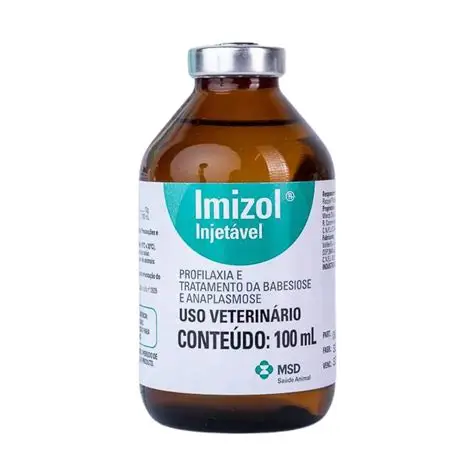
For the South African market, MSD Animal Health identifies Imizol as a veterinary product containing imidocarb dipropionate 12% m/v and describes its use in cattle for babesiosis (redwater) and anaplasmosis (tick-borne gallsickness). The South African presentation includes a 100 ml neutral amber bottle, with storage at 2°C to 25°C and protection from light.
Other jurisdictions use different Imizol formulations. For example, the current Great Britain product is Imizol 85 mg/ml Solution for Injection, equivalent to 121.15 mg/ml imidocarb dipropionate, and is authorized for cattle specifically for bovine babesiosis caused by Babesia divergens.
Because of these formulation and authorization differences, Imizol Injection 100ml should not be treated as one universally identical product in every country.
Imizol is a veterinary medicine associated with imidocarb, an antiprotozoal compound used against certain tick-borne blood-parasite infections in animals.
The 100 ml presentation is particularly important because Imizol is marketed in different package sizes and formulations depending on the country. MSD Animal Health South Africa lists 10 ml, 40 ml and 100 ml presentations for its local Imizol product.
In Great Britain, MSD Animal Health identifies a 100 ml amber-glass presentation of Imizol 85 mg/ml, while the European veterinary database also records a 100 ml multi-dose presentation in Ireland.
The name Imizol Injection 100ml therefore identifies the product and package size, but customers should still confirm the strength, active-ingredient expression, target species and country-specific label before ordering.
Imizol Injection 100ml Overview
| Product characteristic | Information |
|---|---|
| Product name | Imizol |
| Focus keyword | Imizol Injection 100ml |
| Pharmaceutical form | Sterile solution for injection |
| Active ingredient | Imidocarb / imidocarb dipropionate |
| South African formulation | 12% m/v imidocarb dipropionate |
| South African presentation | 100 ml neutral amber bottle |
| Main South African veterinary context | Cattle |
| Published South African uses | Babesiosis and anaplasmosis |
| Great Britain formulation | Imidocarb 85 mg/ml, equivalent to 121.15 mg/ml imidocarb dipropionate |
| Great Britain target species | Cattle |
| Great Britain indication | Treatment and prevention of bovine babesiosis caused by Babesia divergens |
| ATCvet classification | QP51EX01 / imidocarb-related classification varies by database |
| Storage | Country-specific; South African information states 2°C–25°C and protect from light |
| Presentation | 100 ml available in relevant markets |
| Manufacturer/brand association | MSD Animal Health / Intervet |
| Prescription status | Depends on jurisdiction |
| International authorization | Must be verified for the destination country |
The important point is that formulation and authorized use are jurisdiction-specific. The South African product is not necessarily compositionally or legally identical to every product sold under the Imizol name internationally.
What Is Imizol Injection?
Imizol Injection is a veterinary medicine containing imidocarb, commonly presented as imidocarb dipropionate.
Imidocarb belongs to the class of veterinary antiprotozoal medicines used against certain blood-borne protozoal infections. The product is particularly associated with diseases transmitted by ticks.
In South Africa, MSD Animal Health describes Imizol as a product for cattle that acts against organisms responsible for redwater (babesiosis) and tick-borne gallsickness (anaplasmosis). The same source states that the product can also be used preventively in specified redwater-risk circumstances under veterinary guidance.
The Great Britain formulation has a narrower current label. The official product information identifies cattle as the target species and states that it is intended for treatment and prevention of bovine babesiosis caused by Babesia divergens.
This difference illustrates why customers should not assume that a description from one country automatically applies elsewhere.
Imidocarb Dipropionate and Its Veterinary Role
Imidocarb dipropionate is the key active substance associated with Imizol.
The compound is used in veterinary medicine because certain tick-borne organisms affecting blood cells are susceptible to imidocarb. The exact approved disease indications depend on the registered product.
In the South African Imizol documentation, the active constituent is listed as imidocarb dipropionate 12% m/v.
Other regulatory documents express the active ingredient differently. For example, the current Great Britain product lists imidocarb 85 mg/ml, expressed as 121.15 mg/ml imidocarb dipropionate.
These numbers should not be interpreted as contradictory without considering how the active substance is expressed. Veterinary labels may report the active moiety and the salt form separately.
Why the distinction matters
When buying Imizol Injection 100ml internationally, customers should check:
- The stated active substance
- The concentration
- Whether the label expresses the strength as imidocarb or imidocarb dipropionate
- The target species
- The approved indications
- The authorized route
- The package size
- The country of registration
This is especially important because different Imizol registrations can have different strengths and species authorizations.
Product Formulation and Strength
For the South African Imizol product, MSD Animal Health states:
Imidocarb dipropionate 12% m/v.
A 12% m/v formulation corresponds to a product containing 120 mg of imidocarb dipropionate per ml.
However, customers should not assume that every Imizol product labelled 100 ml has exactly the same concentration.
For example, the current Great Britain product is identified as Imizol 85 mg/ml Solution for Injection, with each ml containing 85 mg imidocarb, equivalent to 121.15 mg imidocarb dipropionate.
The U.S. Imizol label likewise describes a 120 mg/ml imidocarb dipropionate sterile solution, but its approved indication is specifically for dogs with babesiosis.
Practical purchasing point
The phrase “Imizol Injection 100ml” should therefore be followed by a check of the actual product label.
Do not rely solely on a retailer’s shortened product title when different national formulations exist.
Veterinary Applications
The South African Imizol product is specifically associated with two major tick-borne disease contexts in cattle:
- Babesiosis
- Anaplasmosis
MSD Animal Health South Africa describes the product as killing organisms associated with redwater and tick-borne gallsickness in cattle.
In other markets, the authorized indication can be narrower. The current British label, for example, limits the indication to treatment and prevention of bovine babesiosis caused by Babesia divergens.
Consequently, the product should be discussed in terms of the specific local registration, rather than treating every online description of Imizol as universally applicable.
Imizol and Cattle Health
Cattle in regions where ticks transmit blood-borne pathogens can face significant veterinary challenges.
Tick-associated diseases can result in clinical signs and production losses, and management may involve:
- Disease diagnosis
- Veterinary treatment
- Herd monitoring
- Tick-control programs
- Biosecurity
- Animal movement management
- Appropriate preventive strategies
- Monitoring of susceptible animals
- Veterinary assessment of local disease risk
Imizol may form part of a veterinary disease-control strategy where its use is authorized.
It should not, however, be viewed as a substitute for broader tick-control and herd-health management.
Veterinary disease control is broader than medication
A comprehensive approach may require assessment of:
- Tick exposure
- Local parasite prevalence
- Herd immunity and susceptibility
- Animal movement
- Previous disease exposure
- Clinical signs
- Laboratory findings
- Existing veterinary treatment
- Withdrawal requirements
The appropriate approach depends on the individual herd and local epidemiological conditions.
Babesiosis and Redwater
Babesiosis, commonly called redwater in cattle, is a tick-borne disease caused by Babesia organisms.
The disease can affect red blood cells and may cause significant clinical illness.
The South African Imizol product is specifically marketed for cattle babesiosis and describes both treatment and prevention-related applications.
The current Great Britain Imizol 85 mg/ml product is specifically authorized for treatment and prevention of bovine babesiosis caused by Babesia divergens.
Redwater risk management
Disease-control decisions may become relevant when cattle:
- Enter a tick-endemic area
- Move between farms
- Are introduced from another region
- Have uncertain exposure histories
- Are exposed to tick populations
- Are being managed during a known disease-risk period
The South African manufacturer information specifically describes veterinary-supervised preventive use in circumstances such as cattle movement into tick areas and herd-management situations where redwater risk is considered significant.
Because disease pressure differs geographically, preventive decisions should be made with local veterinary knowledge.
Anaplasmosis and Tick-Borne Gallsickness
The South African Imizol product is also described for anaplasmosis, referred to in the local product information as tick-borne gallsickness.
Anaplasmosis is another tick-associated blood disease affecting cattle.
The fact that an Imizol product is authorized for anaplasmosis in one country does not automatically establish that the same indication applies to another country’s Imizol registration.
This is one of the most important points for international customers.
Country-specific labeling matters
A customer researching Imizol online may encounter:
- A South African label covering babesiosis and anaplasmosis
- A British label focused on bovine babesiosis
- A U.S. label for canine babesiosis
- Other imidocarb products authorized for cattle, sheep, horses or dogs in certain European countries
These are not necessarily interchangeable products.
Imizol Injection 100ml for Equine Customers
Because World Equine Vet serves an international equine audience, it is important to address horses specifically.
The South African Imizol product cited above is described for cattle, not horses.
Likewise, the current Great Britain Imizol 85 mg/ml authorization identifies cattle as the target species.
However, other products containing imidocarb are authorized for horses in certain European markets. For example, the EU veterinary database records imidocarb products with horses among their target species, including Imidocarb 120 Inj. and Imochem-120.
There are also country-specific Imizol registrations identifying horses, such as a Portuguese product listing for Imizol 85 mg/ml solution for injection for cattle, horses and dogs.
Important distinction
This does not mean that every bottle labelled Imizol Injection 100ml is approved for horses.
Equine use must be determined from the exact product registration in the relevant country.
For an individual horse, a veterinarian should establish:
- The suspected or confirmed disease
- Whether imidocarb is appropriate
- Whether the specific product is authorized for horses
- The permitted route
- Relevant safety considerations
- Competition-medication implications
- Food-chain restrictions where applicable
Key Product Characteristics
Injectable veterinary formulation
Imizol is supplied as a sterile injectable veterinary solution.
Imidocarb-based product
The central active ingredient is imidocarb, usually presented as imidocarb dipropionate.
100 ml presentation
The 100 ml vial is a documented presentation in several markets.
Amber packaging
The South African product is supplied in neutral amber bottles, while other national presentations also use amber glass.
Veterinary disease-control context
The product is associated primarily with tick-borne blood-parasite disease management.
Prescription and regulatory controls
Legal supply status differs between countries. The current Great Britain product is classified as POM-V, while European records for other Imizol formulations identify veterinary prescription requirements.
Benefits and Product Considerations
When evaluating Imizol Injection 100ml, customers may value several product characteristics.
Established veterinary active ingredient
Imidocarb has an established role in veterinary medicine for specific tick-borne blood-parasite diseases.
Recognized cattle-health applications
The South African product is specifically associated with babesiosis and anaplasmosis in cattle.
Multi-dose presentation
A 100 ml vial can be relevant to veterinary practices and cattle-health programs where the registered product presentation is appropriate.
Disease-specific use
The product is not a general-purpose antimicrobial or broad livestock tonic. Its value is tied to the diseases for which the particular formulation is authorized.
Localized disease-management relevance
In regions where babesiosis or anaplasmosis is an established veterinary concern, imidocarb-based medicines can form part of disease-management strategies under veterinary direction.
Safety Information
Imizol requires careful handling because imidocarb can produce adverse effects.
The current British product information reports that cattle may experience cholinergic signs, including effects such as salivation, discomfort, muscle tremor, tachycardia, coughing or colic, and also identifies anaphylactic reactions as a potential adverse event.
The South African product information also classifies Imizol as poisonous and emphasizes veterinary involvement in preventive use.
Veterinary supervision
The product should therefore not be treated like an ordinary nutritional supplement.
A qualified veterinary professional should determine whether the animal has a disease for which the product is appropriate and whether the particular national formulation is suitable.
Operator safety
The product information also contains warnings for people handling the medicine.
The British product materials warn about potential anticholinesterase-type effects in operators and recommend appropriate protective precautions.
Avoid unnecessary skin or eye exposure and follow the safety information supplied with the exact product.
Contraindications and Precautions
The exact contraindications depend on the national formulation.
The current Great Britain Imizol label states that the product should not be administered by the intramuscular or intravenous routes, should not be given as repeat doses, and should not be used in species other than cattle.
This is an important example of why customers should not transfer administration instructions from one country’s Imizol label to another.
The South African product has different route information, demonstrating that national registrations can differ.
Before purchase or use, verify:
- Target species
- Approved indication
- Strength
- Route
- Contraindications
- Withdrawal periods
- Storage requirements
- Shelf life after opening
- Prescription status
- Local registration
Storage and Handling
The South African MSD Animal Health information states that Imizol should be stored at 2°C to 25°C and protected from light.
The British product information gives different storage wording, stating that the product should not be stored above 25°C, should not be frozen, and should be protected from light in its outer carton.
This is another reason to follow the storage instructions on the exact package being purchased.
Protect the product from light
Amber packaging and light-protection instructions are consistent features of several Imizol presentations.
Avoid excessive temperatures
Do not assume that freezing or excessive heat is acceptable simply because the product is sealed.
Check the vial before use
Do not use a vial when:
- The expiry date has passed
- The packaging is damaged
- The identity cannot be confirmed
- The solution has an unexpected appearance
- Contamination is suspected
- Storage history is unknown
Packaging and Presentation
The South African MSD Animal Health product is available in:
- 10 ml
- 40 ml
- 100 ml
neutral amber bottles.
The 100 ml presentation is therefore an established product size rather than simply a retailer-created package description.
The current British Imizol product is also documented in a 100 ml amber Type I glass vial.
Packaging components can differ by market, including stopper material, seal design and external labeling.
Manufacturer and Brand Background
Imizol is associated internationally with MSD Animal Health / Intervet.
The current British authorization identifies Intervet International B.V. as the marketing authorization holder.
The South African product information identifies Intervet South Africa (Pty) Ltd as the registration holder.
Because national subsidiaries and marketing authorization holders can differ, customers should check the information printed on the specific package they receive.
Regulatory and International Considerations
Veterinary medicine regulation is country-specific.
South Africa
MSD Animal Health South Africa lists Imizol with South African registration G0831 under Act 36/1947 and provides a 100 ml presentation.
United Kingdom
The current Great Britain product is Imizol 85 mg/ml Solution for Injection, authorized for cattle and classified as POM-V.
European Union
EU veterinary records show that Imizol and other imidocarb products can have substantially different target species and strengths between countries. One Portuguese Imizol registration lists cattle, dogs and horses, while another Irish Imizol registration lists cattle only.
United States
The current U.S. Imizol label describes a 120 mg/ml imidocarb dipropionate product for treatment of canine babesiosis and states that federal law restricts the drug to use by or on the order of a licensed veterinarian.
International purchasing
International availability does not automatically establish that a product is legally authorized for use in the destination country.
Customers should verify applicable:
- Veterinary medicine regulations
- Import requirements
- Prescription requirements
- Animal-health registrations
- Customs rules
- Food-animal restrictions
- Competition rules
Food-Producing Animal Considerations
Withdrawal periods are especially important when Imizol is used in food-producing cattle.
For the current British Imizol 85 mg/ml product, the documented withdrawal periods are:
- Meat and offal: 213 days
- Milk: 21 days
These values apply to that specific British product authorization.
The South African product information gives different withdrawal information:
- Milk: 6 days
- Meat: 213 days
These differences demonstrate why withdrawal periods must never be copied from an international website without checking the exact national label.
For food-producing animals, the applicable withdrawal period should always come from the product authorization governing the actual treatment.
Purchasing Imizol Injection 100ml
When purchasing Imizol Injection 100ml, product identification should take priority over price alone.
Verify the formulation
Check whether the product states:
- Imidocarb
- Imidocarb dipropionate
- The precise concentration
- The manufacturer
- The country of authorization
Confirm the target species
This is particularly important for equine customers because not every Imizol registration is authorized for horses.
Confirm the package size
Verify that the product is genuinely supplied as a 100 ml vial.
Examine labeling
The label should clearly identify:
- Product name
- Active ingredient
- Strength
- Batch number
- Expiry date
- Manufacturer or authorization holder
- Storage requirements
- Relevant warnings
Consider veterinary requirements
Because Imizol is a veterinary medicinal product and some national formulations are prescription-only, customers should ensure that their purchase complies with local requirements.
Where To Buy Imizol Injection 100ml Online
If you are researching where to buy Imizol Injection 100ml online, begin by confirming that the exact formulation corresponds to the requirements of your country and animal.
World Equine Vet can provide product information for customers researching veterinary medicines, but international customers should independently verify the product’s regulatory status before ordering.
Before purchasing, compare:
- Exact product name
- Active ingredient
- Strength
- 100 ml presentation
- Manufacturer
- Country of origin
- Target species
- Veterinary authorization
- Expiry information
- Packaging condition
- Storage requirements
- Import requirements
For equine customers, the target-species question is particularly important because some current Imizol registrations are cattle-only, while separate imidocarb products are authorized for horses in some markets.
Why Choose World Equine Vet?
At World Equine Vet, product information is designed to help customers understand veterinary medicines before making purchasing decisions.
For Imizol Injection 100ml, this means distinguishing between national formulations instead of assuming that every Imizol product has identical:
- Strength
- Species authorization
- Indications
- Routes
- Withdrawal periods
- Prescription status
- Storage requirements
This distinction is particularly important for international customers.
The product information should be used alongside the exact manufacturer’s label and professional veterinary advice.
Frequently Asked Questions
What is Imizol Injection 100ml?
Imizol Injection 100ml is a 100 ml presentation of a veterinary injectable product containing imidocarb or imidocarb dipropionate. Its approved uses depend on the country-specific formulation and registration.
What is the active ingredient in Imizol?
The principal active ingredient is imidocarb, commonly expressed as imidocarb dipropionate.
What is Imizol used for?
The South African product is described for cattle affected by babesiosis (redwater) and anaplasmosis (tick-borne gallsickness). Other national Imizol products can have narrower or different approved indications.
Is Imizol used for redwater?
Yes. The South African Imizol product is specifically described for babesiosis, commonly known as redwater.
Is Imizol used for anaplasmosis?
The South African product information identifies anaplasmosis, or tick-borne gallsickness, among its indications. This should not automatically be applied to other national formulations.
Is Imizol available in 100 ml?
Yes. MSD Animal Health documents a 100 ml presentation for Imizol in South Africa, and the current British product is also documented in a 100 ml vial.
What strength is Imizol Injection 100ml?
The answer depends on the country and formulation. The South African product is listed as 12% m/v imidocarb dipropionate, while the current British product contains 85 mg/ml imidocarb, equivalent to 121.15 mg/ml imidocarb dipropionate.
Is Imizol used in horses?
Some imidocarb products are authorized for horses in certain countries, and some national Imizol registrations include horses. However, the South African Imizol information cited here is for cattle, and the current British Imizol product is also cattle-only.
Horse use therefore depends on the exact national registration and should be determined by a veterinarian.
Can Imizol Injection 100ml be used for any animal?
No. Target species are determined by the specific veterinary authorization. The current British Imizol label, for example, specifies cattle and states that the product should not be used in other species.
Does Imizol require a prescription?
The legal supply category depends on the country. The current British product is classified as POM-V, while EU records for other Imizol formulations also identify veterinary prescription requirements.
How should Imizol be stored?
The South African product information states that Imizol should be stored between 2°C and 25°C and protected from light.
Other national labels may provide different storage wording, so the exact package instructions should be followed.
Is Imizol refrigerated?
Not necessarily. The South African product information specifies 2°C–25°C, rather than requiring refrigeration.
Other national formulations may have different requirements.
Is Imizol safe for food-producing cattle?
Food-producing cattle may be treated only within the conditions of the applicable veterinary authorization. Withdrawal periods are mandatory and can differ substantially between countries. For example, the British product lists 213 days for meat and offal and 21 days for milk, whereas the South African product lists 213 days for meat and 6 days for milk.
Is Imizol an antibiotic?
Imizol is not generally classified as a conventional antibacterial antibiotic. Its active ingredient, imidocarb, is an antiprotozoal veterinary medicine used against certain blood-borne protozoal organisms.
Is Imizol used to control tick-borne disease?
Imizol is associated with diseases transmitted by ticks, including babesiosis and, in the South African product, anaplasmosis. It should be understood as part of disease management rather than a replacement for tick-control programs.
Who manufactures Imizol?
Imizol is associated internationally with MSD Animal Health / Intervet. The marketing authorization holder and local registration holder can vary by country.
Is Imizol available internationally?
Imizol and imidocarb products are available in multiple markets, but their formulations, target species, indications and legal classifications vary. International availability should not be interpreted as universal authorization.
Final Summary
Imizol Injection 100ml is a veterinary injectable product associated with imidocarb, particularly imidocarb dipropionate, and veterinary management of certain tick-borne blood-parasite diseases.
For the South African market, MSD Animal Health identifies Imizol as containing 12% m/v imidocarb dipropionate and describes its use in cattle for babesiosis (redwater) and anaplasmosis (tick-borne gallsickness). The South African presentation includes a 100 ml amber bottle, with storage at 2°C to 25°C and protection from light.
The exact product should not be assumed to be identical internationally. The current British Imizol 85 mg/ml product, for example, is cattle-only and is authorized for bovine babesiosis caused by Babesia divergens.
Other imidocarb products and some national Imizol registrations include horses among their target species, demonstrating why the country-specific label is essential for equine use.
For customers purchasing Imizol Injection 100ml, the most important checks are the exact strength, formulation, target species, authorized indication, manufacturer, package size, storage requirements, prescription status and applicable withdrawal period.
World Equine Vet recommends verifying these details against the manufacturer’s current documentation and consulting a qualified veterinarian before using an injectable veterinary medicine.
Imizol Injection is a clear, sterile, aqueous solution for the treatment and prevention of Babesiosis in cattle, sheep, horses and dogs, Anaplasmosis in cattle and Ehrlichiosis in dogs
Imizol Injection is a clear, sterile, aqueous solution for the treatment and prevention of Babesiosis in cattle, sheep, horses and dogs, Anaplasmosis in cattle and Ehrlichiosis in dogs.
Vet
Imizol Injection
Print Share
IInjection
This page contains information on Injection for veterinary use.
The information provided typically includes the following:
I Injection Indications
Warnings and cautions for
Direction and dosage information for I Injection
Imizol Injection
This treatment applies to the following species:
Dogs
Company of Imizol Injection: Intervet/Merck Animal Health
(IMIDOCARB DIPROPIONATE)
NADA #141-071, Approved by FDA.
NDC 0061-5158-01
Each mL contains 120 mg of imidocarb dipropionate.
Sterile solution for intramuscular or subcutaneous In
Imizol Injection Caution
Federal (USA) law restricts this drug to use by or on the order of a licensed veterinarian.
Description for Injection
Imizol Injection (imidocarb dipropionate) is a sterile solution containing 120 mg/mL of imidocarb dipropionate suitable for intramuscular or subcutaneous administration. Imidocarb is chemically described as N,N’-bis[3-(4,5-dihydro-1H-imidazol-2-yl)-phenyl]urea dipropionate and has a molecular weight of 496.6. In addition to the active component, imidocarb dipropionate, the formulation also contains propionic acid (22.34 mg/mL), and water for injection.
Imizol Injection Indications
For the treatment of dogs with clinical signs of babesiosis and/or demonstrated Babesia organisms in the blood.
Dosage and Administration for
Use intramuscularly or subcutaneously at a rate of 6.6 mg/kg (3 mg/lb) body weight. Repeat the dose in two (2) weeks, for a total of two (2) treatments.
NOT FOR HUMAN USE. KEEP THIS AND ALL DRUGS OUT OF THE REACH OF CHILDREN. IN THE EVENT OF HUMAN EXPOSURE IMMEDIATELY CALL FOR MEDICAL ADVICE FOR HUMANS.
Oncogenesis: Increased incidence of tumors was observed in rats given imidocarb. Imizol Injection
PRECAUTION :
MUST NOT BE ADMINISTERED INTRAVENOUSLY. The safety and effectiveness of imidocarb have not been determined in puppies or in breeding, lactating, or pregnant animals. Risk versus benefit should be considered before using this drug in dogs with impaired lung, liver, or kidney function.
Do not use this product simultaneously with exposure to cholinesterase-inhibiting drugs, pesticides, or chemicals.
ADVERSE EFFECTS for
Adverse effects commonly seen are pain during injection and mild cholinergic signs such as salivation, nasal drip, or brief episodes of vomiting. Other effects seen less frequently are panting, restlessness, diarrhea, and mild injection site inflammation lasting one to several days. Rarely, injection site ulceration occurs, but the lesion is not resistant to healing.



Reviews
There are no reviews yet.