

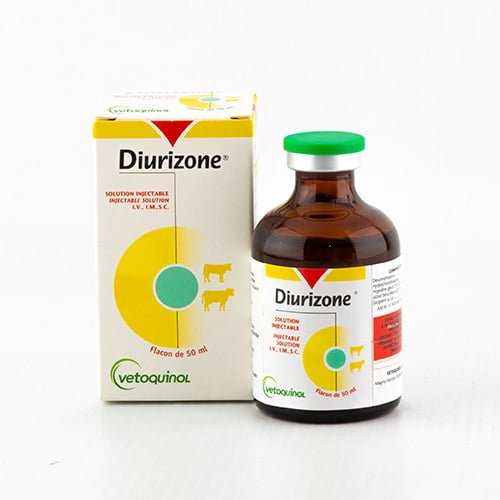

Buy Diurizone Inj 50ml Online
Diurizone Inj 50ml is a veterinary injectable formulation containing hydrochlorothiazide 50 mg/mL and dexamethasone 0.5 mg/mL. The product is associated with Vetoquinol S.A. and is classified pharmacologically under veterinary diuretics. Current European veterinary-medicine records identify a 50 mL amber glass vial and, in the Irish authorization, list cattle and horses that are not intended for human food production as target species.
Diurizone is particularly relevant when veterinary management involves oedema, congestion and fluid accumulation. Hydrochlorothiazide provides the diuretic component, while dexamethasone is a corticosteroid with anti-inflammatory activity. The precise authorized uses and species, however, differ between national registrations. For example, the current French authorization reviewed here is specifically for cattle, while the Irish authorization identifies both cattle and non-food-producing horses.
For that reason, buyers researching Diurizone Inj 50ml should verify the product registration applicable to their country and animal rather than assuming that a description from one market automatically applies elsewhere.
What Is Diurizone Inj 50ml?
Diurizone Inj 50ml is a veterinary injectable medicine combining a thiazide diuretic with a corticosteroid.
Its verified formulation contains:
- Hydrochlorothiazide: 50 mg per mL
- Dexamethasone: 0.5 mg per mL
The current European Union veterinary medicine database identifies Diurizone Injectable as a solution for injection containing these two active substances. The Irish authorization lists cattle and horses not intended for food production among the target species.
The two components have different pharmacological roles.
Hydrochlorothiazide is a thiazide diuretic. It promotes diuresis by reducing renal reabsorption of sodium and chloride, thereby increasing the elimination of water and certain electrolytes.
Dexamethasone is a synthetic glucocorticoid. It has potent anti-inflammatory activity and can modify inflammatory and immune responses. The French product information describes dexamethasone as a synthetic glucocorticoid with low mineralocorticoid activity.
The combination therefore gives Diurizone a different profile from a product containing a diuretic alone.
Diurizone Inj 50ml Overview
| Product characteristic | Verified information |
|---|---|
| Product | Diurizone Injectable |
| Search keyword | Diurizone Inj 50ml |
| Manufacturer / MAH | Vetoquinol S.A. |
| Pharmaceutical form | Solution for injection |
| Hydrochlorothiazide | 50 mg/mL |
| Dexamethasone | 0.5 mg/mL |
| Package | 50 mL amber Type II glass vial in the Irish authorization |
| Target species | Cattle; horses not intended for human consumption in the Irish authorization |
| Veterinary classification | Diuretic / anti-inflammatory combination |
| ATCvet | QC03AX01 |
| Supply status | Veterinary prescription medicine in the Irish authorization |
| Reported routes | IM, IV and SC in the Irish authorization |
| Irish authorization | VPA10521/019/001 |
| Irish authorization holder | Vetoquinol S.A. |
| French authorization | FR/V/9021366 9/1980, cattle-specific |
| Current French presentation | 50 mL |
| Product category | Veterinary pharmaceutical |
The Irish database identifies the 50 mL amber Type II glass vial and states that the medicine is subject to veterinary prescription. The French national product record also identifies a 50 mL presentation and prescription status.
Key Features of Diurizone Inj 50ml
1. Combination diuretic and corticosteroid formulation
Diurizone brings together hydrochlorothiazide and dexamethasone in a single injectable veterinary product.
This is significant because the medicine is not simply a conventional diuretic. The corticosteroid component adds anti-inflammatory and immunomodulating activity.
2. 50 mg/mL hydrochlorothiazide
Hydrochlorothiazide is the principal diuretic component at 50 mg/mL.
3. 0.5 mg/mL dexamethasone
Dexamethasone is present at 0.5 mg/mL.
4. Injectable solution
Diurizone is supplied as a solution for injection rather than an oral tablet or powder.
5. Equine relevance varies by jurisdiction
This point is especially important.
The current Irish authorization identifies horses not intended for human consumption as target animals.
By contrast, the French authorization reviewed for this product is specifically titled Diurizone Solution Injectable pour Bovins and lists cattle as the target species.
Therefore, an international buyer should not assume that horse use is authorized everywhere simply because the product is listed for horses in one market.
6. 50 mL presentation
The 50 mL vial is an established presentation. The Irish database specifies an amber Type II glass vial with chlorobutyl stopper and aluminum seal.
Product Details
Active ingredient: Hydrochlorothiazide
Hydrochlorothiazide belongs to the thiazide class of diuretics.
The French product information explains that hydrochlorothiazide increases diuresis through reduced reabsorption of sodium and chloride, accompanied by increased elimination of potassium, bicarbonate and magnesium.
This pharmacological action explains why hydrochlorothiazide may be used when a veterinarian needs to influence fluid balance.
It also explains why electrolyte status matters.
Diuretic therapy is not simply about removing excess water. Changes in electrolyte handling can be clinically important, particularly in animals with existing renal, cardiac or metabolic problems.
Active ingredient: Dexamethasone
Dexamethasone is a synthetic glucocorticoid.
The product information describes its anti-inflammatory and immunomodulating properties. Corticosteroids can reduce inflammatory responses by affecting processes including capillary dilation, leukocyte migration and phagocytosis.
Its presence means that Diurizone should be considered a pharmacologically active corticosteroid product rather than simply a fluid-management injection.
Excipients and Formulation
The French product specification identifies the following excipients:
- Propylene glycol
- Benzyl alcohol
- Dimethylacetamide
- Macrogol 300
- Water for injections
It describes the medicine as a colourless, slightly viscous solution.
The exact excipient profile matters for animals with known hypersensitivity or when a veterinarian is evaluating compatibility with another treatment.
How Diurizone Works
Diurizone has two pharmacological components that operate differently.
Hydrochlorothiazide and fluid elimination
Hydrochlorothiazide acts primarily through the kidneys.
By reducing sodium and chloride reabsorption, it promotes increased urinary excretion of water and certain electrolytes. The result is increased diuresis.
This can be relevant to veterinary management where excessive fluid accumulation or oedema forms part of the clinical picture.
Dexamethasone and inflammation
Dexamethasone works through glucocorticoid pathways and has potent anti-inflammatory activity.
Inflammation can contribute to tissue swelling, discomfort and other clinical signs. Dexamethasone can therefore address an inflammatory component while hydrochlorothiazide addresses fluid balance.
Why the combination matters
The two components should not be viewed as interchangeable.
Hydrochlorothiazide is primarily associated with fluid and electrolyte management.
Dexamethasone is primarily associated with inflammatory and immune responses.
Consequently, Diurizone’s use should be based on a veterinarian’s assessment of why oedema or congestion is occurring.
Veterinary and Equine Context
Diurizone is particularly interesting for equine customers because current European documentation is not completely uniform across countries.
The Irish veterinary medicines database currently lists:
- Cattle
- Horse, non-food-producing
as target species.
The same Irish record lists intramuscular, intravenous and subcutaneous administration routes.
However, the French national authorization identifies the product as a bovine injectable and lists cattle as the target species.
This is an important example of why international veterinary product pages should distinguish documented product information from assumptions about universal authorization.
For an equine customer, the relevant question is not simply:
“Is Diurizone used in horses?”
Instead, the more accurate question is:
“Is this specific Diurizone presentation authorized for horses in my jurisdiction, and under what conditions?”
That distinction can affect lawful purchasing, veterinary use and competition considerations.
Intended Veterinary Uses
Current Irish product documentation identifies the following uses for cattle:
- Udder congestion and oedema
- Persistent oedema during lactation
- Pulmonary congestion and oedema
- Oedema associated with surgical wounds
- Oedema associated with allergic conditions
For horses, the same Irish documentation identifies:
- Generalized congestion and oedema
- Sheath oedema
- Anasarca
- Oedema associated with allergic conditions
These indications are derived from the current Irish product information and should not be assumed to apply to every national registration.
The French authorization, meanwhile, lists bovine indications involving udder oedema, persistent lactation oedema, pulmonary congestion/oedema, oedema of surgical wounds and allergic manifestations.
Oedema and Fluid Accumulation
Oedema is an accumulation of fluid in tissues.
In horses, visible swelling can have many different causes. These may include:
- Local injury
- Inflammation
- Allergic reactions
- Reduced lymphatic drainage
- Vascular problems
- Systemic disease
- Trauma
- Infection
- Generalized fluid imbalance
A diuretic can influence fluid elimination, but that does not automatically identify or resolve the underlying cause.
This is why Diurizone should not be viewed as a universal treatment for any swollen area.
A veterinarian should determine whether the swelling represents a condition for which this medication is appropriate.
Pulmonary Congestion and Oedema
The product’s cattle authorization includes pulmonary congestion and oedema among its indications.
Respiratory distress and pulmonary fluid accumulation can represent potentially serious clinical conditions.
A horse or other large animal experiencing breathing difficulty requires prompt veterinary evaluation. Diurizone should not be treated as an emergency substitute for diagnosis, oxygen support or other veterinary intervention.
Sheath Oedema in Horses
The Irish product information specifically identifies sheath oedema among the listed equine indications.
Sheath swelling can have numerous underlying causes, so veterinary examination remains important.
Diurizone’s inclusion of hydrochlorothiazide and dexamethasone means that both fluid balance and inflammatory mechanisms may be relevant to its use, but that does not establish that every case of sheath swelling should be treated with the product.
Anasarca
Anasarca refers to extensive or generalized subcutaneous oedema.
The Irish product documentation specifically includes anasarca among the equine indications.
Generalized oedema can be associated with systemic disease and should therefore be evaluated rather than managed solely on the basis of visible swelling.
Benefits and Important Considerations
Helps support veterinary management of oedema
The diuretic component is designed to increase fluid elimination.
Provides corticosteroid anti-inflammatory activity
Dexamethasone provides a pharmacologically distinct anti-inflammatory component.
Injectable formulation
The injectable presentation allows veterinary professionals to select the route and treatment approach specified by the applicable product authorization.
Established 50 mL presentation
The 50 mL vial is documented in European veterinary databases.
Important limitation: it is not appropriate for every swelling problem
Oedema is a clinical sign rather than a single disease.
The appropriate treatment depends on the underlying cause.
Important limitation: authorization varies by country
Horse authorization in Ireland does not establish horse authorization in France or another jurisdiction. The French record reviewed here is cattle-specific.
Safety and Precautions
Diurizone requires careful veterinary consideration because it contains both a diuretic and a corticosteroid.
The current French product information identifies several contraindications and precautions associated with the two active ingredients.
Pregnancy
The French product information states that use is not recommended during pregnancy and identifies pregnancy-related concerns associated with both components. It also notes that corticosteroid administration late in gestation can cause premature parturition or abortion in ruminants.
The applicable local product label should always be consulted for the specific species.
Kidney disease
The French product information recommends caution in renal insufficiency.
Because hydrochlorothiazide acts through the kidneys and affects electrolyte excretion, renal status is an important clinical consideration.
Electrolyte and fluid imbalance
The product information specifically identifies water and electrolyte imbalance as situations requiring caution.
This is particularly relevant to diuretic therapy.
Liver disease
Caution is also identified for hepatic insufficiency.
Diabetes
The French product information identifies diabetes among relevant corticosteroid-related contraindications/precautions.
Cardiac conditions
Cardiac disease is also identified among situations requiring particular consideration in the French documentation.
Glaucoma
Glaucoma appears among the listed corticosteroid-related contraindications in the French product information.
Hypersensitivity
The product should not be used where there is known hypersensitivity to the active substances or excipients. The French information also identifies hypersensitivity to thiazides or sulfonamides as relevant to hydrochlorothiazide.
Potential Adverse Effects
The current French product information reports several adverse effects associated with the formulation, particularly with prolonged corticosteroid exposure or other specific circumstances.
Reported effects include:
- Polyuria
- Polydipsia
- Polyphagia
- Delayed wound healing
- Opportunistic infection
- Metabolic/nutritional changes
- Reduced milk production
- Hypokalaemia
- Other corticosteroid-related effects
The frequency is described as indeterminate in the French documentation.
This information reinforces why Diurizone should be used according to veterinary direction rather than as a general-purpose swelling remedy.
Drug Interactions
The product’s interaction profile is important.
NSAIDs
The French product information states that concurrent administration of corticosteroids with NSAIDs may increase the risk of gastrointestinal ulceration.
This is particularly relevant when treating horses because NSAIDs are commonly used in equine veterinary medicine.
Veterinarians should therefore know about all current or recently administered anti-inflammatory medicines before selecting a corticosteroid-containing product.
Vaccines
The French documentation states that corticosteroids can reduce the immune response to vaccination and advises against simultaneous administration of dexamethasone with vaccines.
Sulfonamides
The product information states that sulfonamides can potentiate hydrochlorothiazide activity.
A complete medication history is therefore important before treatment.
Competition Horse Considerations
For owners and trainers of competition horses, Diurizone requires additional attention.
The product contains dexamethasone, a corticosteroid, and may therefore be subject to medication-control rules.
Competition organizations can regulate:
- Corticosteroids
- Therapeutic substances
- Detection thresholds
- Permitted concentrations
- Treatment documentation
- Medication withdrawal periods
- Competition eligibility
These requirements differ between organizations and jurisdictions.
A product being authorized for veterinary treatment does not automatically mean that it is permitted around competition.
Before using Diurizone in a competition horse, the responsible veterinarian and trainer should check the current rules of the applicable governing organization.
World Equine Vet does not recommend relying on generic “competition safe” claims because medication regulations can change and differ between organizations.
Food-Producing Animal Considerations
The regulatory status of Diurizone is particularly important for food-producing animals.
The Irish authorization identifies horses that are not intended for human food production, while cattle are subject to withdrawal periods.
For the Irish authorization, the listed cattle withdrawal period is:
- Meat and offal: 28 days
- Milk: 7 days
These periods are associated with the specific Irish authorization and routes documented there.
The French product information gives different withdrawal periods:
- Meat and offal: 3 days
- Milk: 2 days
This difference is an excellent example of why withdrawal periods must never be copied from one country’s product information and applied internationally.
For food-producing animals, always follow the withdrawal period applicable to the exact product registration and jurisdiction.
Administration
Current Irish product information identifies:
- Intramuscular administration
- Intravenous administration
- Subcutaneous administration
for Diurizone Injectable.
The French cattle product information also identifies intravenous, intramuscular and subcutaneous routes.
Because this is an injectable pharmaceutical product, administration should be carried out by a veterinarian or appropriately trained professional in accordance with the current authorized product information.
Why dosage is not provided here
The published product information contains dosing instructions, but this page intentionally does not reproduce a patient-specific dosage schedule.
The correct regimen can depend on:
- Species
- Body weight
- Diagnosis
- Clinical severity
- Hydration
- Kidney function
- Electrolyte status
- Concurrent medications
- Pregnancy status
- Local authorization
- Route of administration
A veterinarian should determine the appropriate regimen using the current label for the relevant jurisdiction.
Storage and Handling
The French product information states that the product does not require special storage conditions and identifies a two-year shelf life when packaged for sale. It also states a 28-day period after first opening for that French authorization.
The Irish authorization identifies a 50 mL amber Type II glass vial with a chlorobutyl stopper and aluminum seal.
Because storage and in-use periods can vary between registrations, buyers should follow the instructions on the specific product supplied.
Good handling practices include:
- Check the expiry date.
- Inspect the vial before use.
- Keep the original labeling with the medicine.
- Maintain appropriate aseptic handling.
- Keep the container appropriately secured.
- Do not use damaged packaging.
- Follow the applicable opened-container period.
- Dispose of unused veterinary medicine according to local requirements.
The French documentation specifically states that unused veterinary medicines should not be discarded into drains or household waste and should instead be handled through appropriate collection systems.
Product Form and Presentation
Diurizone Inj 50ml is supplied as a 50 mL injectable vial.
The current Irish record describes the packaging as:
50 mL amber Type II glass vial + chlorobutyl stopper + aluminum seal.
The French national record likewise identifies a 50 mL presentation.
The solution is described in the French product information as colourless and slightly viscous.
Manufacturer Information
The product is associated with Vetoquinol S.A.
The current Irish veterinary medicines database identifies Vetoquinol S.A. as the marketing authorization holder and manufacturing site for batch release.
The French product information likewise identifies Vetoquinol S.A. as the marketing authorization holder.
The French authorization dates to 1980, while the Irish authorization record dates to 1989.
Regulatory Status
Diurizone’s regulatory profile demonstrates why country-specific verification matters.
Ireland
The current EU veterinary database lists:
- Valid authorization
- Ireland
- Veterinary prescription medicine
- Cattle
- Non-food-producing horses
- 50 mL vial
under authorization VPA10521/019/001.
France
The French national veterinary database lists:
- Diurizone Solution Injectable pour Bovins
- Cattle
- 50 mL vial
- Veterinary prescription status
- Authorization FR/V/9021366 9/1980.
What this means for international buyers
It means that the phrase “Diurizone Inj 50ml” should not be treated as having one universal regulatory profile.
The same brand/product family may have different:
- Target species
- Indications
- Withdrawal periods
- Supply classifications
- Local packaging
- Authorization conditions
depending on the market.
Purchasing Considerations
When researching Diurizone Inj 50ml online, buyers should confirm more than the product name.
Verify the active ingredients
The expected formulation is:
Hydrochlorothiazide 50 mg/mL + dexamethasone 0.5 mg/mL.
Verify the manufacturer
The product is associated with Vetoquinol S.A.
Verify the presentation
The product is documented in a 50 mL vial.
Verify species authorization
This is particularly important for horse owners because the Irish and French records reviewed have different target-species listings.
Verify prescription requirements
The Irish record classifies the product as subject to veterinary prescription.
Verify destination-country requirements
International customers should check whether the product is authorized, importable and legally obtainable in their jurisdiction.
Where To Buy Diurizone Inj 50ml Online
Customers researching where to buy Diurizone Inj 50ml online should look for a clearly identified veterinary product with the correct formulation, manufacturer and package presentation.
World Equine Vet can provide a convenient product-shopping environment for customers researching veterinary medicines, but purchasing should always remain consistent with applicable veterinary-pharmaceutical laws.
Before ordering, confirm:
- Diurizone Injectable
- 50 mL presentation
- Hydrochlorothiazide 50 mg/mL
- Dexamethasone 0.5 mg/mL
- Vetoquinol manufacturer information
- Appropriate labeling
- Expiry information
- Batch/lot identification
- Destination-country authorization
- Prescription requirements where applicable
- Shipping and import restrictions
For equine customers, it is particularly important to verify whether the product is authorized for horses in the destination jurisdiction. The current Irish record supports non-food-producing horse use, whereas the French record reviewed is cattle-specific.
World Equine Vet should therefore present the product with transparent specifications rather than making a blanket claim that Diurizone is approved for every species or available in every country.
A qualified veterinarian should remain involved in decisions regarding diagnosis, treatment selection and administration.
Frequently Asked Questions
What is Diurizone Inj 50ml?
Diurizone Inj 50ml is a veterinary injectable solution containing hydrochlorothiazide 50 mg/mL and dexamethasone 0.5 mg/mL.
What does Diurizone contain?
Each mL contains:
- Hydrochlorothiazide — 50 mg
- Dexamethasone — 0.5 mg
The formulation also contains excipients including propylene glycol, benzyl alcohol, dimethylacetamide, macrogol 300 and water for injections.
Is Diurizone a diuretic?
Yes. Hydrochlorothiazide is a thiazide diuretic and is responsible for the product’s diuretic activity.
Is Diurizone an anti-inflammatory?
It contains dexamethasone, a corticosteroid with potent anti-inflammatory activity. Therefore, Diurizone combines diuretic and corticosteroid pharmacological effects.
Is Diurizone used in horses?
In the current Irish authorization reviewed, horses that are not intended for human food production are listed as a target species.
However, horse authorization is not universal. The French authorization reviewed lists cattle only.
What is Diurizone used for in horses?
The Irish product information lists generalized congestion and oedema, sheath oedema, anasarca and oedema associated with allergic conditions for horses.
Is Diurizone suitable for every swollen horse?
No. Swelling can have many causes, and the appropriate treatment depends on the underlying condition. Veterinary assessment is important before using a pharmaceutical diuretic/corticosteroid combination.
What is the package size?
The product is documented in a 50 mL vial.
Is Diurizone prescription-only?
The current Irish veterinary medicines database identifies Diurizone Injectable as a veterinary medicinal product subject to veterinary prescription.
The French national record also identifies it as a prescription veterinary medicine.
Can Diurizone be used with an NSAID?
This requires veterinary evaluation. The French product information states that concurrent corticosteroid and NSAID administration can increase the risk of gastrointestinal ulceration.
Can Diurizone be given around vaccination?
The French product information states that corticosteroids can reduce the immune response to vaccination and advises against simultaneous administration of dexamethasone with vaccines.
Does Diurizone have withdrawal periods?
Yes, where the product is authorized for food-producing animals, applicable withdrawal periods exist. They can differ substantially by country. For example, the Irish record lists 28 days for cattle meat/offal and 7 days for milk, while the French cattle authorization lists 3 days for meat/offal and 2 days for milk.
Can Diurizone be used in a competition horse?
Competition use should be checked against the current rules of the applicable governing organization because the product contains dexamethasone. Veterinary authorization does not automatically establish competition eligibility.
How should Diurizone be stored?
Storage instructions should be taken from the current label for the specific market. The French product information states that no special storage conditions are required and gives a two-year shelf life for the unopened product under its authorization.
What manufacturer makes Diurizone?
The product is associated with Vetoquinol S.A.
Is Diurizone the same as a hydrochlorothiazide-only injection?
No. Diurizone contains both hydrochlorothiazide and dexamethasone. Buyers should check the complete formulation before ordering.
Final Summary
Diurizone Inj 50ml is a veterinary injectable combination containing hydrochlorothiazide 50 mg/mL and dexamethasone 0.5 mg/mL. It is associated with Vetoquinol S.A. and is supplied as a 50 mL injectable presentation.
Hydrochlorothiazide provides the diuretic component, while dexamethasone contributes potent corticosteroid anti-inflammatory activity. This combination is designed for specific veterinary circumstances involving fluid accumulation, oedema and inflammation rather than routine use for unexplained swelling.
The product has documented equine relevance in the current Irish authorization, which lists non-food-producing horses among its target species and identifies uses including generalized oedema, sheath oedema, anasarca and allergic-condition-associated oedema.
At the same time, national registrations can differ. The French authorization reviewed is specifically for cattle and has different indications and withdrawal periods.
This makes accurate regulatory verification particularly important for international buyers.
For customers considering Diurizone Inj 50ml, the essential checks are the exact formulation, 50 mL presentation, manufacturer, authorized species, current local registration, prescription requirements, withdrawal information where applicable, competition rules and professional veterinary guidance.
Diurizone inj 50ml Cattle and sheep : congestion and oedema of the udder, persistant lactation in oedema, pulmonary oedema and congestion, oedematous
infiltration of surgical wounds, oedema in allergic conditions.
Diurizone inj 50ml
Cattle: 10 ml a day for 3 days.
Calves : 2 ml for 40 -50 kg of b.w. daily for 3 days
Hydrochlorothiazide 50 mg, dexamethasone 0,50 mg Diurizone inj 50ml Cattle and sheep : congestion and oedema of the udder, persistant lactation in oedema, pulmonary oedema and congestion,
infiltration of surgical wounds, oedema in allergic conditions.
Dosage and administration
I.V., I.M. or S.C
Cattle: 10 ml a day for 3 days.
Calves : 2 ml for 40 -50 kg of b.w. daily for 3 days
Hydrochlorothiazide 50 mg, dexamethasone 0,50 mg
Indication Diurizone inj 50ml
Diurizone inj 50ml Cattle and sheep : congestion and oedema of the udder, persistant lactation in oedema, pulmonary oedema and congestion, oedematous
infiltration of surgical wounds, oedema in allergic conditions.
Dosage and administrationDiurizone inj 50ml
I.V., I.M. or S.C
Cattle: 10 ml a day for 3 days.
Calves : 2 ml for 40 -50 kg of b.w. daily for 3 days
Hydrochlorothiazide 50 mg, dexamethasone 0,50 mg
Indication Diurizone
Diurizone inj 50ml Cattle and sheep : congestion and oedema of the udder, persistant lactation in oedema, pulmonary oedema and congestion, oedematous
infiltration of surgical wounds, oedema in allergic conditions.
Dosage and administration
I.V., I.M. or S.C Diurizone inj 50ml
Cattle: 10 ml a day for 3 days.
Calves : 2 ml for 40 -50 kg of b.w. daily for 3 days
Hydrochlorothiazide 50 mg, dexamethasone 0,50 mg
Diurizone inj 50ml Cattle and sheep : congestion and oedema of the udder, persistant lactation in oedema, pulmonary oedema and congestion, oedematous
infiltration of surgical wounds, oedema in allergic conditions.
Hydrochlorothiazide 50 mg, dexamethasone 0,50 mg
Indication
e Cattle and sheep : congestion and oedema of the udder, persistant lactation in oedema, pulmonary oedema and congestion, oedematous
infiltration of surgical wounds, oedema in allergic conditions.=
Diurizone inj 50ml Cattle and sheep : congestion and oedema of the udder, persistant lactation in oedema, pulmonary oedema and congestion, oedematous
infiltration of surgical wounds, oedema in allergic conditions.
Hydrochlorothiazide 50 mg, dexamethasone 0,50 mg


Reviews
There are no reviews yet.